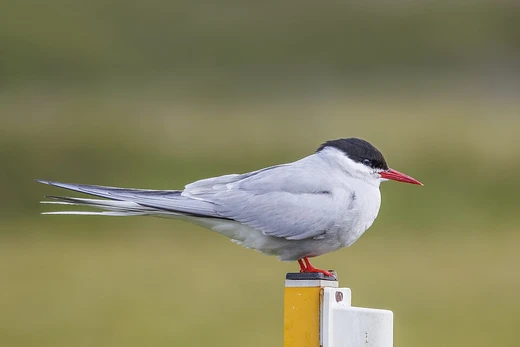
Arctic warbler
A migratory leaf warbler with one of the longest insectivore migrations.

Wikipedia / Wikimedia Commons
The Arctic warbler (Phylloscopus borealis) is a small passerine bird that breeds in birch or mixed birch forest near water across Fennoscandia and the northern Palearctic, with a breeding population also established in Alaska. It is strongly migratory, wintering entirely in southeast Asia, and is notable for having one of the longest migrations of any Old World insectivorous bird.
- scientific_name
- Phylloscopus borealis
- genus_meaning
- Ancient Greek phullon, 'leaf', and skopos, 'seeker'
- specific_meaning
- Latin borealis, 'northern'
- breeding_range
- Fennoscandia, northern Palearctic, Alaska
- wintering_range
- Southeast Asia
- habitat
- Birch or mixed birch forest near water
- diet
- Insectivorous
Lore & Background
The Arctic warbler is a typical leaf warbler in appearance, greyish-green above and off-white below, with two wing bars that distinguish it from most similar species except the greenish warbler. It is similar in size to the greenish warbler and has a fine, pointed bill without a notably heavier or dagger-like shape, nor a consistently dark tip to the lower mandible. Its song is a fast trill. The nest is placed on the ground in a low shrub.
Reader's Guide
The Arctic warbler is significant as a widespread breeder across northern Eurasia and Alaska, and for its extreme migration to Southeast Asia. It traditionally included populations in Kamchatka, the Kuril Islands, and Japan, but genetic and vocal evidence led to these being split into separate species: the Kamchatka leaf warbler and the Japanese leaf warbler. This taxonomic revision highlights the importance of modern methods in ornithology. The species occurs as an autumn vagrant in western Europe and is annual in Great Britain, with 225 confirmed sightings in Britain between 1958 and 2001. Its genus name, Phylloscopus, means 'leaf seeker', reflecting its habit of foraging among foliage. The Arctic warbler's presence in North America represents a successful colonization from the Old World, and its long migration underscores the ecological demands on insectivorous birds in northern latitudes.
Did You Know?
- The Arctic warbler has one of the longest migrations of any Old World insectivorous bird.
- Its two wing bars distinguish it from most similar species except the greenish warbler.
- There were 225 confirmed Arctic warbler sightings in Britain between 1958 and 2001.
- The genus name Phylloscopus comes from Ancient Greek for 'leaf seeker'.
Frequently Asked Questions
What is the Arctic warbler?
It is a small leaf warbler (genus Phylloscopus) that belongs to the passerine order and feeds primarily on insects. The species is most recognized for undertaking one of the longest migratory journeys of any Old World insectivore.
Where does the Arctic warbler breed?
It nests in birch or mixed birch woodland close to water across Fennoscandia and the broader northern Palearctic, with a separate breeding population now established in Alaska.
Where does the Arctic warbler spend the winter?
It migrates entirely to southeast Asia, where it overwinters before returning north for the breeding season.
What do the words in 'Phylloscopus borealis' actually mean?
The genus name comes from Ancient Greek phullon ('leaf') and skopos ('seeker'), while the specific epithet is Latin borealis, meaning 'northern.'
Why do birders consider the Arctic warbler special?
Its round-trip distance between northern breeding grounds and its southeast Asian wintering range ranks among the longest of any insect-eating Old World bird, making it a remarkable long-distance migrant.
More in Birds of the Arctic 1-24
Spotted an error? Know more?
This is a living reference — every entry is fact-audited, and reader corrections feed straight into our audit queue. Suggest an edit · See this site's audit record