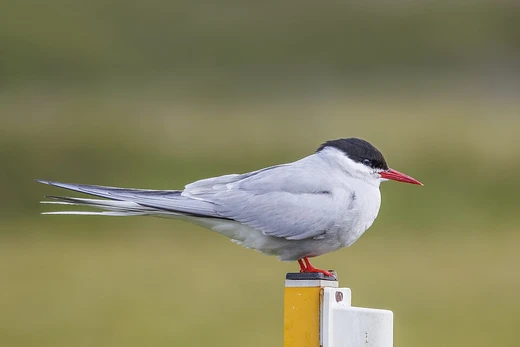
Black turnstone
Small wading bird breeding only in Alaska, wintering on Pacific coasts.
The black turnstone (Arenaria melanocephala) is a species of small wading bird in the sandpiper family, Scolopacidae, formerly sometimes placed in the plover family, Charadriidae. It is one of two turnstone species in the genus Arenaria, the other being the ruddy turnstone. Native to the west coast of North America, it breeds only in Alaska and is notable for its black-and-white plumage, upturned bill, and habit of flipping over stones to find prey.
- Scientific name
- Arenaria melanocephala
- Length
- 22–25 cm (8.7–9.8 in)
- Weight
- 100–170 g (3.5–6.0 oz)
- Breeding range
- Western Alaska, primarily Yukon–Kuskokwim Delta
- Winter range
- Pacific coast from southern Alaska to northwest Mexico
- World population
- Estimated 95,000 birds
- Conservation status
- Not specified in source
Lore & Background
The black turnstone breeds in western Alaska from the Alaska Peninsula to Point Hope, with the bulk of the population nesting in the Yukon–Kuskokwim Delta. It usually nests near the coast but also occurs inland along rivers and lakes. The world population is estimated at 95,000 birds, about 80,000 of which are in the Yukon–Kuskokwim Delta. It winters on rocky shores along the Pacific coast from southern Alaska to Baja California and Sonora, with a single record from Nayarit. Vagrant birds have been recorded from Yukon, the Northwest Territories, and San Cristóbal Island in the Galápagos Islands.
Reader's Guide
The black turnstone is a distinctive wader of the North American Pacific coast, notable for its black-and-white breeding plumage and its feeding behavior of using its bill to turn over stones, algal mats, and other objects to access hidden invertebrates. It feeds mainly on crustaceans and mollusks in winter and insects during the breeding season, also taking seeds, eggs, and carrion. Its breeding grounds are primarily in western Alaska, where it arrives from early May to early June, often returning to the same territory and mate. The nest is a scrape dug mainly by the male, usually among sedges, grasses, or under willows. Four eggs are laid, incubated by both parents for 21–24 days; chicks are precocial and fledge after 25–34 days. The species is similar to the ruddy turnstone but differs in having darker plumage, narrower white wingbar, and darker legs. Its calls include a rattling trill heard year-round, a screeching alarm call, and a soft purring call to chicks. The black turnstone is a well-studied species in North American ornithology, with its population concentrated in the Yukon–Kuskokwim Delta, making it an important indicator of coastal and wetland health in Alaska.
Did You Know?
- The black turnstone is one of only two species in the genus Arenaria, the other being the ruddy turnstone.
- It uses its bill to turn over stones, algal mats, and other objects to find prey hidden beneath.
- The world population is estimated at 95,000 birds, with about 80,000 nesting in the Yukon–Kuskokwim Delta.
- Vagrant black turnstones have been recorded as far as the Galápagos Islands.
Frequently Asked Questions
What is a Black Turnstone?
It is a small shorebird in the sandpiper family, instantly recognizable by its bold black-and-white plumage and a distinctly upturned bill. It is one of only two species classified under the genus Arenaria.
Where does the Black Turnstone breed?
This species is restricted to western Alaska during the nesting season, with the Yukon-Kuskokwim Delta serving as its core breeding area. It does not reproduce anywhere else in the world.
How does a Black Turnstone find its food?
It is famous for prying and flipping over rocks and stones along the intertidal zone to expose hidden invertebrates. This very behavior is what gives the word 'turnstone' its meaning.
How big is a Black Turnstone?
Adults measure roughly 22 to 25 centimeters in length and weigh between 100 and 170 grams, placing it firmly in the small wading-bird category.
How many Black Turnstones are there in the wild?
The global population is estimated at approximately 95,000 individuals. Outside the Alaskan breeding season, they disperse along the Pacific coast from southern Alaska down to northwest Mexico.
More in Birds of the Arctic 1-24
Spotted an error? Know more?
This is a living reference — every entry is fact-audited, and reader corrections feed straight into our audit queue. Suggest an edit · See this site's audit record