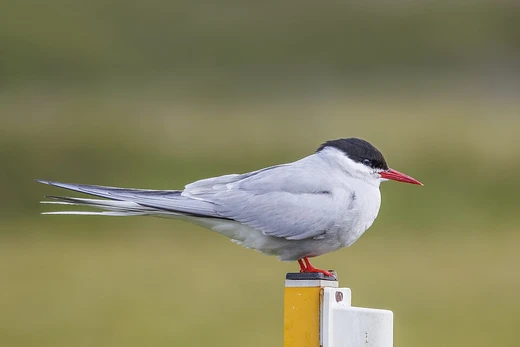
Buff-breasted sandpiper
A small shorebird migrating from Arctic tundra to South American pampas.
The buff-breasted sandpiper (Calidris subruficollis) is a small shorebird notable for its long annual migration from the Arctic region of North America to the pampas region of South America. Its species name derives from Latin subrufus, meaning 'reddish,' and collis, meaning '-necked' or '-throated.' It is a calidrid sandpiper that breeds in open Arctic tundra and spends the non-breeding season mainly in Argentina and Uruguay.
- Scientific name
- Calidris subruficollis
- Field
- Ornithology
- Known for
- Long-distance migration from Arctic North America to South American pampas
- Habitat
- Open Arctic tundra (breeding); short-grass habitats like airfields or golf courses (non-breeding)
- Diet
- Insects and other invertebrates, including Bombus polaris
- Conservation status
- Not specified in source
Lore & Background
The buff-breasted sandpiper is brown above with a buff face and underparts in all plumages, a short bill, and yellow legs. Males are larger than females, and juveniles resemble adults but may be paler on the rear underparts. It nests on the ground in Canada and Alaska, laying four eggs. The male performs a display raising its wings to show white undersides, a behavior also seen on migration even when no other buff-breasted sandpipers are present.
Reader's Guide
The buff-breasted sandpiper is significant as a very long-distance migrant, traveling from the Arctic region of North America to the pampas of South America. It migrates mainly through central North America and is uncommon on coasts, but occurs regularly as a wanderer in Western Europe, where it is not classed as rare in Great Britain or Ireland. Only the pectoral sandpiper is a more common American shorebird visitor to Europe. The species has been sighted in South Asia on at least three occasions, possibly wind-blown from the Great Plains Flyway, and in Australia on at least eight occasions. It has also been recorded in Sri Lanka and South Africa. Its legacy includes suspected hybridization with the white-rumped or Baird's sandpiper, and its tame nature makes it notable among shorebirds.
Did You Know?
- The species name subruficollis comes from Latin subrufus, 'reddish,' and collis, '-necked/-throated.'
- It preys on Bombus polaris, a bumblebee found within the Arctic Circle, and feeds them to its young.
- It has been sighted in South Asia on at least three occasions and in Australia on at least eight occasions.
- Only the pectoral sandpiper is a more common American shorebird visitor to Europe.
Frequently Asked Questions
What is the Buff-breasted sandpiper?
It is a small calidrid shorebird (Calidris subruficollis) best known for undertaking one of the longest annual migrations of any bird species.
Where does the Buff-breasted sandpiper breed and where does it winter?
It nests in open tundra across Arctic North America, then flies all the way down to the pampas grasslands of Argentina and Uruguay for the non-breeding season.
What does a Buff-breasted sandpiper eat?
Its diet consists mainly of insects and other small invertebrates, and it has even been recorded preying on the Arctic bumblebee (Bombus polaris).
What does the scientific name Calidris subruficollis actually mean?
The species epithet is Latin: "subrufus" means reddish and "collis" refers to the neck or throat, pointing to the bird's distinctive buffy plumage.
Where can I spot a Buff-breasted sandpiper outside the Arctic?
In the non-breeding season it gravitates toward short-grass habitats such as airfields and golf courses, and in South America it is most at home in the open pampas.
More in Birds of the Arctic 1-24
Spotted an error? Know more?
This is a living reference — every entry is fact-audited, and reader corrections feed straight into our audit queue. Suggest an edit · See this site's audit record