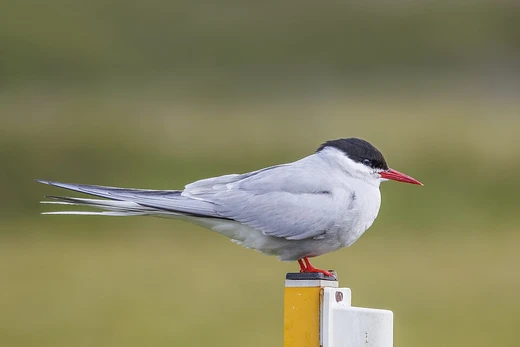
Barnacle goose
A goose once believed to hatch from driftwood and barnacles.

Wikipedia / Wikimedia Commons
The barnacle goose (Branta leucopsis) is a species of black goose first classified by Johann Matthäus Bechstein in 1803. It is notable for its white face, black head and neck, and silver-grey barred wings, and for its medieval association with the goose barnacle, a myth that influenced dietary practices and persisted until the late 18th century.
- Scientific name
- Branta leucopsis
- First classified by
- Johann Matthäus Bechstein (1803)
- Size
- 55–70 cm long, wingspan 120–145 cm
- Weight
- 1.21–2.23 kg
- Closest relative
- Cackling goose
- Number of populations
- 5 (3 original, 2 established since the 1960s)
- Conservation status
- Common and widespread; population increasing
Lore & Background
In medieval times, the barnacle goose and brant goose were not distinguished, and were thought to spawn from goose barnacles. This legend, dating to at least the 12th century, was reported by Gerald of Wales, accepted by William Turner, and claimed by John Gerard to have been seen emerging from shells. The myth persisted until the end of the 18th century. In County Kerry, Catholics abstaining from meat during Lent could eat this bird because it was considered fish. The word 'barnacle' may come from a Celtic word for 'limpet,' but the sense-history appears to go in the opposite direction.
Reader's Guide
The barnacle goose is significant for its unusual reproductive myth, which influenced medieval religious dietary laws. Pope Innocent III at the Fourth Council of the Lateran (1215) explicitly prohibited eating these geese during Lent, arguing they lived and fed like ducks. The question also arose in Jewish dietary law (Halakha). Ecologically, the species has five distinct populations, two established since the 1960s, and its numbers have generally increased, though the Svalbard population suffered a severe HPAI outbreak in the early 2020s, losing about 31% of its individuals before recovering. The goose nests on cliffs or small islands to avoid predators like Arctic foxes and polar bears; goslings must jump from heights to reach feeding areas, with only 50% surviving the first month. The species is protected under the Agreement on the Conservation of African-Eurasian Migratory Waterbirds.
Did You Know?
- The barnacle goose was first classified by Johann Matthäus Bechstein in 1803.
- Medieval legend held that barnacle geese were born from driftwood and goose barnacles, a myth that persisted until the late 18th century.
- The Svalbard population lost about 31% of its individuals to highly pathogenic avian influenza in the 2021/22 winter, but recovered by the 2023/24 winter.
- Goslings jump from cliffs up to 200–300 m high on their first day, and only 50% survive the first month.
Frequently Asked Questions
What is a barnacle goose and who first described it?
The barnacle goose (Branta leucopsis) is a compact black goose species that Johann Matthäus Bechstein formally classified in 1803. Adults typically measure 55 to 70 cm in body length and weigh roughly 1.2 to 2.2 kg.
How do you tell a barnacle goose apart from other geese?
Its most eye-catching feature is the sharp contrast between a solid black head and neck and a bright white face. The wings are silver-grey with fine barring, and the overall build is noticeably smaller than most other geese, with a wingspan of about 120 to 145 cm.
Where does the name 'barnacle' come from?
In medieval Europe, a widespread legend held that these geese hatched directly from barnacles clinging to driftwood rather than from eggs. That belief shaped church dietary restrictions and stuck around in popular culture until roughly the late 1700s.
How many wild populations of barnacle geese exist today?
There are five recognized populations in total: three original colonies plus two additional groups that were established beginning in the 1960s. This keeps the species' global distribution fairly limited.
What is the barnacle goose's closest living relative?
It sits closest to the cackling goose within the genus Branta, sharing the same black-goose lineage. Both are members of the broader waterfowl family but occupy very different geographic ranges.
More in Birds of the Arctic 1-24
Spotted an error? Know more?
This is a living reference — every entry is fact-audited, and reader corrections feed straight into our audit queue. Suggest an edit · See this site's audit record