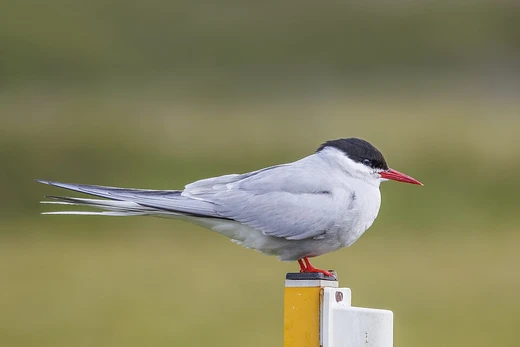
Central Asian Flyway
A major Eurasian flyway for migratory waterbirds.

Wikipedia / Wikimedia Commons
The Central Asian Flyway (CAF) is a major migration route for waterbirds, spanning a large continental area of Eurasia between the Arctic Ocean, the Indian Ocean, and associated island chains. It covers 30 countries in North, Central, and South Asia and the Trans-Caucasus, with its range centered on the Indian subcontinent, one of the three major wintering areas for waterfowl in the Old World. The flyway supports at least 279 migratory waterbird populations of 182 species, including 29 globally threatened or near-threatened species.
- field
- Migratory bird flyway
- region
- North, Central, and South Asia and Trans-Caucasus
- countries_covered
- 30
- migratory_waterbird_populations
- 279
- species_covered
- 182
- threatened_species
- 29
- core_wintering_area
- Indian subcontinent
Lore & Background
The Central Asian Flyway (CAF) is an operational concept used to manage waterfowl populations across their entire migration space. Its range is centered on the Indian subcontinent, which is one of three major wintering areas for waterfowl in the Old World, the others being in Africa (African-Eurasian Flyway) and Southeast Asia (East Asian–Australasian Flyway). The flyway covers 30 countries, with its northern catchment area overlapping with both the AEWA and EAAF, mostly within the Russian Federation. Sixteen of the 30 countries are also located in the AEWA area.
Reader's Guide
The Central Asian Flyway is significant as a critical migration corridor for hundreds of waterbird species, many of which are globally threatened. It encompasses a vast geographic range from Siberia to the Indian Ocean, and its conservation involves cooperation among 30 countries through international conventions such as the Convention on the Conservation of Migratory Species (CMS), the Agreement on the Conservation of African-Eurasian Migratory Waterbirds (AEWA), and the Ramsar Convention. The flyway includes species completely or largely restricted to its range, such as the critically endangered northern bald ibis, white-bellied heron, and Baer's pochard, as well as species like the Siberian crane and spoon-billed sandpiper whose breeding ranges are largely restricted to the region. Conservation efforts are supported by development agencies including UNEP, UNDP, the World Bank, and ADB, and NGOs such as BirdLife International, IUCN, and WWF. Bangladesh and India are key countries within the flyway, with Bangladesh hosting extensive wetlands and India serving as the core country, supporting 257 species of water birds and having identified more than 300 potential Ramsar sites.
Did You Know?
- The Central Asian Flyway covers 30 countries, including Afghanistan, India, China, Russia, and the Maldives.
- It supports at least 279 migratory waterbird populations of 182 species, including 29 globally threatened or near-threatened species.
- The flyway's range is centered on the Indian subcontinent, one of three major wintering areas for waterfowl in the Old World.
- Bangladesh, a country within the flyway, has more than two-thirds of its landmass classified as wetlands according to the Ramsar definition.
Frequently Asked Questions
What is the Central Asian Flyway?
The Central Asian Flyway is one of the great migratory corridors for waterbirds, stretching across a vast swath of Eurasia from the Arctic Ocean down toward the Indian Ocean and its surrounding island chains. It links breeding grounds in the far north with wintering habitats across three continents' worth of Asian and Trans-Caucasus territory.
How many countries does the Central Asian Flyway cover?
The flyway passes through 30 countries spanning North, Central, and South Asia as well as the Trans-Caucasus region. Its wintering range is anchored on the Indian subcontinent, which serves as one of the Old World's three principal waterfowl overwintering zones.
How many waterbird species use the Central Asian Flyway?
At least 279 migratory waterbird populations belonging to 182 different species rely on this route each year. Among them are 29 species classified as globally threatened or near-threatened, making the corridor a critical lifeline for vulnerable populations.
Why do fans and ornithologists consider the Central Asian Flyway significant?
It is the single most species-rich waterbird migration pathway in the Old World, funneling hundreds of populations through a shared chain of wetlands and stopover sites. Losing any one leg of the route would cascade into population declines for dozens of species, which is why conservation attention has focused so heavily on its 30-country stretch.
Where does the Central Asian Flyway begin and end?
The corridor connects Arctic Ocean shorelines in the north with the Indian Ocean and its associated island chains in the south. In between, it threads through the Trans-Caucasus, the Central Asian steppe, and the South Asian subcontinent, forming one of the longest continuous waterbird migration routes on Earth.
More in Birds of the Arctic 1-24
Spotted an error? Know more?
This is a living reference — every entry is fact-audited, and reader corrections feed straight into our audit queue. Suggest an edit · See this site's audit record