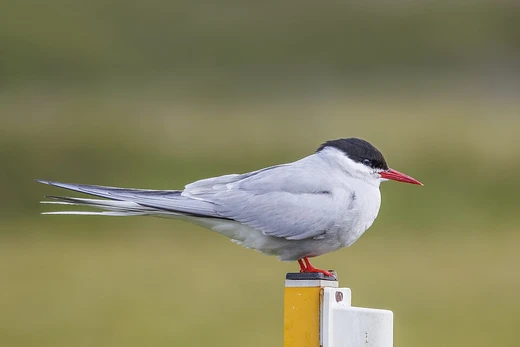
Black-legged kittiwake
A pelagic gull named for its call, nesting on sheer cliffs.
The black-legged kittiwake (Rissa tridactyla) is a seabird species in the gull family Laridae. First described by Carl Linnaeus in 1758, it is known for its shrill call that gives it its English name. It is the most pelagic of the gulls, spending most of the year at sea and nesting on sheer sea cliffs.
- Scientific name
- Rissa tridactyla
- First described
- 1758 by Carl Linnaeus
- Family
- Laridae
- Length
- 37–41 cm
- Wingspan
- 91–105 cm
- Mass
- 305–525 g
- Subspecies
- Two: R. t. tridactyla (Atlantic) and R. t. pollicaris (Pacific)
Lore & Background
The black-legged kittiwake was formally described by Carl Linnaeus in the 10th edition of his Systema Naturae (1758) as Larus tridactylus. It is now placed in the genus Rissa, introduced by James Stephens in 1826. The genus name comes from the Icelandic word 'rita', and the specific name tridactyla means 'three-toed', referring to its reduced or absent hind toe. Two subspecies are recognized: R. t. tridactyla in the North Atlantic and R. t. pollicaris in the North Pacific, the latter having a small hind toe.
Kittiwakes are colonial nesters that form monogamous pairs and exhibit biparental care. They nest in large numbers on the sheerest sea cliffs, a behavior unique among gulls to the Rissa species. Their breeding season runs from May to September. Outside this period, they are almost exclusively at sea, rarely seen inland except as vagrants. The species is highly gregarious and known for its graceful, agile flight.
Adults have white head and body, grey back, black-tipped wings, black legs, and a yellow bill. The inside of the mouth is rich red due to carotenoids and vitamin A from their diet, and this color is flashed during greeting displays. Juveniles have a black 'W' across the wings and a black bill, gradually acquiring adult plumage by four years old. The old fisherman's name for juveniles is 'tarrock'.
Reader's Guide
The black-legged kittiwake is significant as a widespread Arctic and subarctic seabird that exemplifies extreme pelagic adaptation among gulls. Its reliance on sheer sea cliffs for nesting is unique within the Laridae family, and its colonial breeding behavior has made it a subject of study in avian social behavior and reproductive success. The species' red mouth pigmentation, linked to diet and mate signaling, provides insight into carotenoid-based ornamentation. The two subspecies, distinguished by hind toe presence and slight size differences, illustrate geographic variation across the Atlantic and Pacific. The kittiwake's English name, derived from its call, reflects a direct link between human observation and nomenclature. Its ability to colonize man-made structures, first noted in 1949 on the River Tyne, shows adaptability to changing environments. As a pelagic bird rarely seen inland, it represents a specialized niche in marine ecosystems, and its protracted moult and gradual plumage maturation offer a model for developmental biology in seabirds.
Did You Know?
- The English name 'kittiwake' comes from its call, a shrill 'kittee-wa-aaake'.
- It is unique among gulls in having a very small or no hind toe, reflected in its scientific name tridactyla ('three-toed').
- The inside of its mouth is rich red due to carotenoid pigments and vitamin A obtained from its diet.
- Juvenile black-legged kittiwakes were historically called 'tarrock' by fishermen.
Frequently Asked Questions
What is the black-legged kittiwake?
It's a small seabird in the gull family Laridae, first formally described by Carl Linnaeus in 1758. Unlike many gulls that hang around harbors or shorelines, the kittiwake is the most ocean-bound member of the group, living out on open water for most of the year.
Where does the name 'kittiwake' come from?
The English common name is simply an onomatopoeia echoing the bird's loud, shrill vocalization. It isn't tied to a person, place, or old legend—it's just a sound-word mimicking the call itself.
Where does it nest and how does it spend its time?
For the bulk of the calendar the kittiwake forages far out on the open ocean, making it the most pelagic gull in its family. During breeding season it returns to sheer, vertical sea cliffs where it builds its nest on narrow ledges.
How big is a black-legged kittiwake?
Adults run about 37–41 cm in body length with a wingspan of roughly 91–105 cm. Their mass typically falls between 305 and 525 grams, placing them in the smaller end of the gull spectrum.
What sets the kittiwake apart from other gulls?
Its extreme open-ocean lifestyle is the standout trait; most Laridae relatives spend a good deal of time near coastlines or on land, whereas the kittiwake is genuinely a deep-water bird. Combined with its exclusive cliff-face nesting and that piercing call, it occupies a niche few other gulls share.
More in Birds of the Arctic 1-24
Spotted an error? Know more?
This is a living reference — every entry is fact-audited, and reader corrections feed straight into our audit queue. Suggest an edit · See this site's audit record