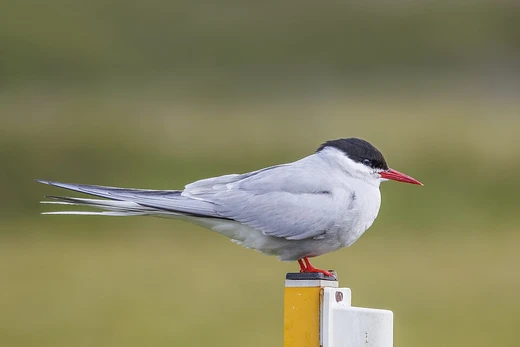
Common murre
A seabird that flies underwater and breeds on bare cliff ledges.
The common murre or common guillemot (Uria aalge) is a large auk with a circumpolar distribution in low-Arctic and boreal waters of the North Atlantic and North Pacific. It spends most of its time at sea, coming to land only to breed on rocky cliff shores or islands, and is notable for its dense breeding colonies and its ability to dive to depths of up to 180 meters using its wings for propulsion.
- Scientific name
- Uria aalge
- Length
- 38–46 cm (15–18 in)
- Wingspan
- 61–73 cm (24–29 in)
- Weight
- 775–1,250 g (1 lb 11½ oz – 2 lb 12 oz)
- Flight speed
- 80 km/h (50 mph)
- Diving depth
- 30–60 m typical; up to 180 m recorded
- Population
- Approximately 7.3 million breeding pairs or 18 million individuals
Lore & Background
The common murre was formally described in 1763 by Danish bishop Erik Pontoppidan under the binomial name Colymbus aalge, with the type locality in Iceland. It is now placed in the genus Uria, named from Ancient Greek ouria, a waterbird mentioned by Athenaeus. The species shares this genus with the thick-billed murre, and together with the razorbill, little auk, and extinct great auk forms the tribe Alcini. Five subspecies are recognized, including U. a. aalge, U. a. hyperborea, U. a. albionis, U. a. inornata, and U. a. californica, distributed across coastal regions of the North Atlantic and North Pacific.
Reader's Guide
The common murre is significant as a pursuit-diving seabird that forages by swimming underwater using its wings, typically diving to 30–60 meters but recorded as deep as 180 meters. It breeds in extremely dense colonies on cliff ledges, laying a single egg incubated between the adult's feet with no nest. Chicks leave the ledge at about 20 days old, gliding to the sea accompanied by the male parent, and are capable of diving immediately. Both adults moult after breeding and become flightless for 1–2 months. The species faces threats from hunting, pollution, and oil spills, and a massive die-off in the northeast Pacific was reported in 2016, with birds found emaciated and starving. A marine heat wave between 2014 and 2016 killed half the murre population in Alaska, and as of 2024 the species has not recovered. Its large population of about 18 million individuals had been stable prior to these events.
Did You Know?
- Common murres can dive to depths of up to 180 m (590 ft) and remain underwater for a couple of minutes.
- Chicks leave the nesting ledge at 20–21 days old, unable to fly, and glide to the sea accompanied by the male parent.
- Some individuals in the North Atlantic, called 'bridled guillemots', have a white ring around the eye extending back as a white line.
- A marine heat wave between 2014 and 2016 killed half the murre population in Alaska, and as of 2024 the species has yet to recover.
Frequently Asked Questions
Who is the Common Murre?
The Common Murre (Uria aalge) is a large auk species with a circumpolar range across the North Atlantic and North Pacific, spending the vast majority of its life on open water. It comes ashore only during the breeding season, favoring bare, rocky cliff faces and small offshore islands.
What are the Common Murre's diving abilities?
Rather than relying on its legs, this bird uses its wings as underwater paddles to chase prey at typical depths of 30 to 60 metres. The deepest dive recorded for the species reaches a staggering 180 metres.
Where does the Common Murre breed?
Each breeding season, thousands of these birds converge on exposed cliff ledges and coastal islands in low-Arctic and boreal zones. The resulting colonies are among the densest seabird gatherings in the world, with birds packed shoulder-to-shoulder along narrow shorelines.
How fast can a Common Murre fly?
In the air it cruises at roughly 80 km/h (50 mph) with a wingspan between 61 and 73 cm. At 38 to 46 cm in length and weighing up to about 1.25 kg, it is one of the larger members of the auk family.
Why is the Common Murre important?
As a key predator of small fish and marine invertebrates, it plays a vital role in Arctic and sub-Arctic food chains. Its enormous, tightly clustered colonies also make it a valuable bellwether for monitoring ocean warming and shifting prey availability.
More in Birds of the Arctic 1-24
Spotted an error? Know more?
This is a living reference — every entry is fact-audited, and reader corrections feed straight into our audit queue. Suggest an edit · See this site's audit record