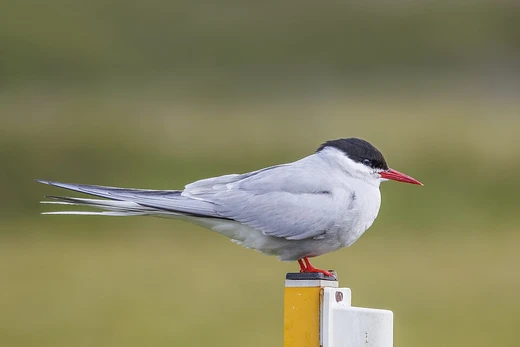
Dunlin
A circumpolar Arctic wader with a distinctive black belly.
The dunlin (Calidris alpina) is a small wader in the genus Calidris. It is a circumpolar breeder in Arctic or subarctic regions, with populations ranging from short-distance migrants in western Europe to long-distance migrants in northern Asia and North America. The species is notable for its distinctive black belly in breeding plumage and its highly gregarious winter flocks on coastal mudflats.
- Scientific name
- Calidris alpina
- Length
- 16–20 cm
- Weight
- 34–77 g
- Wingspan
- 38–43 cm
- Conservation status
- Near Threatened (IUCN)
- Number of subspecies
- 10
Lore & Background
The dunlin was formally described by Carl Linnaeus in 1758 under the name Tringa alpina, with the type locality given as Lapland. The English name derives from 'dunling', first recorded in 1531–1532, combining 'dun' (dull brown) with the suffix '-ling'. The genus name Calidris comes from Ancient Greek, used by Aristotle for grey waterside birds, while the specific epithet alpina refers to alpine tundra habitats generally, not the Alps specifically.
Ten subspecies are recognized, differing mainly in breeding plumage, bill length, and range. These include C. a. arctica from northeast Greenland, C. a. schinzii from Iceland and the British Isles, and C. a. alpina from northern Scandinavia and northwest Siberia. The subspecies vary in the extent of rufous plumage and the size of the black belly patch, with bill length also differing between sexes—females having longer bills than males.
The dunlin's bill tip has a soft covering filled with blood and nerve endings, forming a sensitive probe for locating invertebrate prey in mud and sand. Its call is a typical sandpiper 'chreep', and the display song is a harsh trill.
Reader's Guide
The dunlin is one of the most common waders throughout its breeding and wintering ranges, often serving as a benchmark for comparing other wader species. It is highly gregarious in winter, forming large flocks on coastal mudflats or sandy beaches, and is known for synchronized swirling flight displays during migration. The species shows strong philopatry, particularly in the southern subspecies C. a. schinzii, which returns to natal patches in Sweden and Finland, though habitat fragmentation has reduced connectivity and increased inbreeding risks.
Its conservation status is 'Near Threatened' according to the IUCN, with the population decreasing but still very large. The southern subspecies C. a. schinzii is of particular concern, declining and endangered in some areas—in Denmark, only 95 pairs remained in 2021, down from 50,000 pairs a century earlier. The northeast Greenland subspecies C. a. arctica is also endangered with a very small population. The dunlin is covered by the Agreement on the Conservation of African-Eurasian Migratory Waterbirds (AEWA). Apparent hybrids with the white-rumped sandpiper and purple sandpiper have been reported from the Atlantic coasts of North America and Europe, respectively.
Did You Know?
- The English name 'dunlin' is a dialect form of 'dunling', first recorded in 1531–1532, from 'dun' (dull brown) and '-ling' (person or thing with that quality).
- The dunlin's bill tip has a soft covering filled with blood and nerve endings, forming a sensitive probe for locating invertebrate prey in mud and sand.
- Ten subspecies are recognized, differing mainly in breeding plumage and bill length; females have longer bills than males.
- In Denmark, only 95 pairs of the southern subspecies C. a. schinzii remained in 2021, compared to 50,000 pairs a century earlier.
Frequently Asked Questions
What is a Dunlin?
The dunlin is a small wader in the genus Calidris, measuring roughly 16 to 20 centimeters in length. It breeds across Arctic and subarctic regions worldwide and is one of the most recognizable shorebirds on coastal mudflats.
What makes Dunlin visually distinctive?
In breeding plumage, the dunlin displays a striking black belly that sets it apart from other small sandpipers. Outside of breeding season, it blends into the muted gray-brown tones of its winter coastal habitats.
Where does Dunlin breed and where does it winter?
As a circumpolar breeder, it nests across the Arctic and subarctic from western Europe through Asia to North America. Its wintering grounds span coastal mudflats worldwide, with some populations making only short local moves while others travel vast distances across continents.
What is Dunlin's conservation status?
The IUCN classifies the dunlin as Near Threatened, reflecting ongoing pressures on its coastal and wetland habitats. The species is recognized as having ten subspecies across its global range.
How does Dunlin behave in winter flocks?
Dunlins are highly gregarious outside the breeding season, gathering in large, noisy groups on exposed mudflats and estuaries. This flocking behavior makes them easy to spot and useful as indicators of coastal ecosystem health.
More in Birds of the Arctic 1-24
Spotted an error? Know more?
This is a living reference — every entry is fact-audited, and reader corrections feed straight into our audit queue. Suggest an edit · See this site's audit record