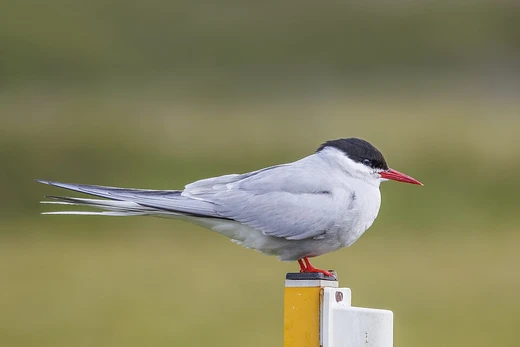
Eskimo curlew
Once abundant shorebird now critically endangered or possibly extinct.
The Eskimo curlew (Numenius borealis), also called the northern curlew, belongs to the Scolopacidae family of shorebirds. In the late 1800s, this bird was incredibly abundant across the tundra of western Arctic Canada and Alaska, with millions present. However, hunters killed thousands each year, driving the population to collapse. No confirmed sighting has occurred since 1963, and the last reliable report was in 1987, so the species is now listed as Critically Endangered, with many experts considering it likely extinct.
The curlew measures about 30 cm (12 in) long. Its diet consists mainly of insects and berries.
- Scientific name
- Numenius borealis
- Length
- about 30 cm (12 in)
- Weight
- approximately 360 g (13 oz)
- Wingspan
- 70 cm (28 in)
- First described
- 1772 by Johann Reinhold Forster
- Status
- Critically Endangered or possibly extinct
- Last confirmed sighting
- 1963 (Barbados)
Lore & Background
The Eskimo curlew bred on the tundra of western Arctic Canada and Alaska and migrated to the Pampas of Argentina in late summer, returning in February. During fall migration in Canada, it fed mostly on berries; on the breeding grounds and during other migration periods, it ate insects, snails, and other invertebrates, including the extinct Rocky Mountain locust. Its nests were made of dried grass or leaves on the ground, and the eggs were green with brown splotches. The specific incubation behavior is unknown, and the birds evidently did not attack intruders approaching their nests.
Reader's Guide
The Eskimo curlew's significance lies in its dramatic decline from a population of millions to near or total extinction within a few decades. At the end of the 19th century, as many as 2 million birds per year were killed for their meat, which was considered a delicacy. The last confirmed sightings were in 1962 on Galveston Island, Texas (photographed), and on Barbados in 1963 (a specimen collected). A reliable report of 23 birds in Texas in 1981 and a few dozen unconfirmed reports from scattered locales between 1964 and 2006 have not yielded a confirmed record. The species is fully protected in Argentina, Brazil, Canada, Mexico, and the United States, and hunting has been outlawed since around 1916. Its plight inspired the novel and Emmy Award-winning 1972 ABC Afterschool Special Last of the Curlews, and it appears as plate CCCLVII of Audubon's Birds of America. The species serves as a cautionary example of how unregulated hunting can drive a once-abundant bird to the brink of extinction.
Did You Know?
- The Eskimo curlew is also called doe-bird, doughbird, fute, little curlew, and prairie pigeon.
- It forms a species pair with the Asian little curlew (Numenius minutus) but is slightly larger, longer-winged, shorter legged, and warmer in plumage tone.
- The only certain way to distinguish the Eskimo curlew from the similar Hudsonian whimbrel is confirmation of its unbarred undersides of the primaries.
- Some conjecture that Eskimo curlews and American golden plover attracted Christopher Columbus to land after 65 days at sea on his first voyage.
More in Birds of the Arctic 1-24
Spotted an error? Know more?
This is a living reference — every entry is fact-audited, and reader corrections feed straight into our audit queue. Suggest an edit · See this site's audit record