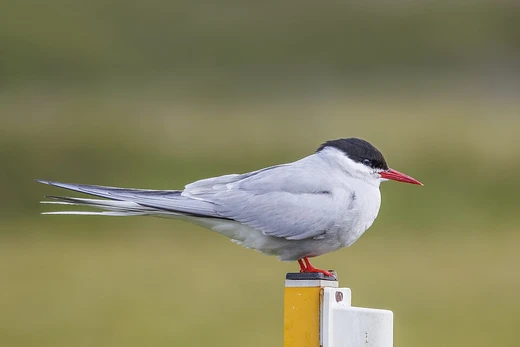
Great skua
A large, aggressive seabird that pirates food from other birds.
The great skua (Stercorarius skua), also known as the bonxie in Britain, is a large seabird in the family Stercorariidae. It is roughly the size of a herring gull and is notable for its aggressive kleptoparasitic behavior, often stealing food from other seabirds. It breeds in Iceland, Norway, the Faroe Islands, and on Scottish islands, and is a migrant species that winters at sea in the Atlantic Ocean.
- Scientific name
- Stercorarius skua
- Also known as
- Bonxie
- Length
- 50–58 cm (20–23 in)
- Wingspan
- 125–140 cm (49–55 in)
- Average weight (male)
- 1.27 kg (2 lb 13 oz)
- Average weight (female)
- 1.41 kg (3 lb 2 oz)
- Breeding range
- Iceland, Norway, Faroe Islands, Scottish islands
Lore & Background
The great skua was described from the Faroe Islands and Iceland by Danish zoologist Morten Thrane Brünnich in 1764 under the binomial name Catharacta skua. It is now placed in the genus Stercorarius, introduced by French zoologist Mathurin Jacques Brisson in 1760. The English name and species name 'skua' is believed to originate from the Faroese skúvur or skúgvur, and is the only known bird name to originate from the Faroes that has come into regular use elsewhere. In Britain, it is sometimes called bonxie, a Shetland name of Norse origin. The genus name Stercorarius is Latin and means 'of dung'; the food disgorged by other birds when pursued by skuas was once thought to be excrement. The species is monotypic: no subspecies are recognized.
Genetic studies have found surprising similarities between the great skua and the pomarine skua, despite their dissimilar appearance. Many ornithologists now believe either that the great skua originated as a hybrid between the pomarine skua and one of the southern-hemisphere species, presumably as a result of vagrancy or migration across the equator by the southern species, or that the pomarine skua evolved from hybridization of the great skua and one of the small Arctic species. Despite its name, the great skua is marginally smaller on average than the other three large southern-hemisphere skuas, although not by enough to distinguish them by size in the field.
Reader's Guide
The great skua is significant as an aerial apex predator and aggressive kleptoparasite in North Atlantic ecosystems. It deliberately harasses birds as large as gannets to steal food, and also readily kills and eats smaller birds such as puffins. Its diet includes fish, other seabirds, eggs, carrion, and occasionally berries and small mammals, including young rabbits, lambs, and even pony foals. Probably its most prolific food source is by-catch abandoned by fishing vessels. The great skua shows little to no fear of humans, dive-bombing anyone approaching its nest. Unusual behavior was recorded in 2007 on St Kilda, where ecologists using night vision gear observed skuas preying on Leach's storm petrels at night, a remarkable strategy for a seabird. Its breeding range includes Iceland, Norway, the Faroe Islands, and Scottish islands, with some individuals breeding on mainland Scotland and in northwest Ireland. It is a migrant species, wintering at sea in the Atlantic Ocean and regularly reaching North American waters, and is vagrant to Mediterranean countries such as Turkey. The great skua's call is a harsh hah-hah-hah-hah; quacking and croaking noises have also been heard.
Did You Know?
- The great skua is the only known bird name to originate from the Faroe Islands that has come into regular use elsewhere.
- It has been known to prey on lambs and even pony foals.
- In 2007, ecologists observed great skuas preying on Leach's storm petrels at night using night vision gear.
- The genus name Stercorarius is Latin for 'of dung', because the food disgorged by other birds when pursued by skuas was once thought to be excrement.
More in Birds of the Arctic 1-24
Spotted an error? Know more?
This is a living reference — every entry is fact-audited, and reader corrections feed straight into our audit queue. Suggest an edit · See this site's audit record