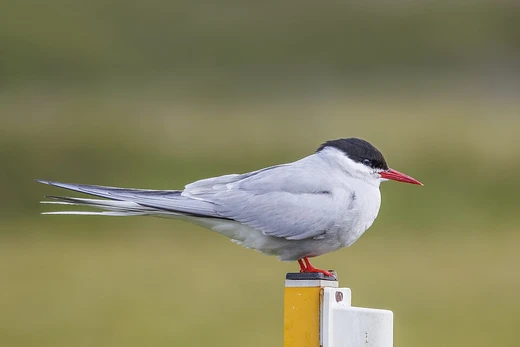
Grey plover
Arctic-breeding plover with near-global coastal winter range.
The grey plover, also known as the black-bellied plover (Pluvialis squatarola), is a large plover that breeds in Arctic regions and undertakes long-distance migrations to coastal areas worldwide. It is notable for its distinct seasonal plumages and its status as a species of conservation concern.
- Scientific name
- Pluvialis squatarola
- Length
- 27–30 cm
- Wingspan
- 71–83 cm
- Weight
- 190–280 g (up to 345 g before migration)
- IUCN status
- Vulnerable
- Subspecies
- 3 recognized
Lore & Background
In breeding plumage (spring and summer), adults show black face, neck, breast, and belly with white borders, and spotted black-and-white back and wings. In winter, they become plain grey above with a grey-speckled breast and white belly. The black inner flanks and underwing axillaries distinguish it from other Pluvialis species. Juveniles and first-winter birds resemble winter adults but have blacker back feathers with creamy white edging. The species forages on beaches and tidal flats for small molluscs, polychaete worms, crustaceans, and insects, and is less gregarious than its relatives, feeding in widely spaced individuals.
Reader's Guide
The grey plover is significant as a long-distance migrant with a nearly worldwide coastal distribution outside the breeding season. Its breeding habitat spans Arctic islands and coastal areas of Alaska, Canada, and Russia, where it nests on the ground in dry open tundra. The species undertakes regular non-stop transcontinental flights over Asia, Europe, and North America, though it rarely lands inland except on large lake shores. The International Union for Conservation of Nature has judged its threat level as 'Vulnerable,' and it is covered by the Agreement on the Conservation of African-Eurasian Migratory Waterbirds. Its distinct plumages and migratory behavior make it a subject of ornithological study and conservation monitoring across multiple continents.
Did You Know?
- The grey plover is known as 'black-bellied plover' in the New World and 'grey plover' in the Old World.
- Its genus name Pluvialis means 'relating to rain' in Latin, from a belief that they flocked when rain was imminent.
- The species can weigh up to 345 g in preparation for migration.
- Young birds do not breed until two years old and typically remain on wintering grounds until their second summer.
More in Birds of the Arctic 1-24
Spotted an error? Know more?
This is a living reference — every entry is fact-audited, and reader corrections feed straight into our audit queue. Suggest an edit · See this site's audit record