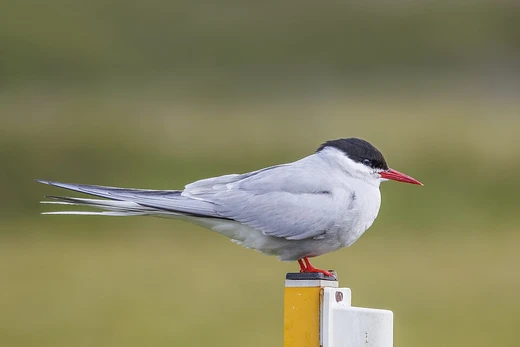
Iceland gull
Arctic-breeding gull named after Iceland but not breeding there.
The Iceland gull (Larus glaucoides) is a medium-sized gull. Despite its name, it does not breed in Iceland; it only appears there during winter. Its breeding grounds are in the Arctic regions of Canada and Greenland. The genus name comes from the Latin *larus*, which likely referred to a gull or other large seabird. The species name *glaucoides* indicates its similarity to the glaucous gull (*Larus hyperboreus*), as *-oides* is Ancient Greek for "resembling."
This gull is relatively slender and light for its size. Adults measure 50 to 64 cm (20 to 25 in) in length, with a wingspan of 115 to 150 cm (45 to 59 in) and a weight of 480 to 1,100 g (1.06 to 2.43 lb). Standard measurements include a wing chord of 37.9 to 44.3 cm (14.9 to 17.4 in), a bill of 3.6 to 5.4 cm (1.4 to 2.1 in), and a tarsus of 4.9 to 6.7 cm (1.9 to 2.6 in). It is smaller and has a thinner bill than the much larger glaucous gull, and it is usually smaller than the herring gull. It takes four years to reach full maturity.
Its call is a laughing cry similar to that of the herring gull, but higher in pitch.
The Iceland gull is migratory. It winters in the North Atlantic as far south as the British Isles and the northernmost states of the eastern United States, and also in the interior of North America as far west as the western Great Lakes. In Europe, it is much less common than the similar glaucous gull. It breeds either in colonies or singly on coasts and cliffs, building a nest lined with grass, moss, or seaweed on the ground or a cliff. It typically lays two or three light brown eggs. Like most *Larus* gulls, it is omnivorous, eating fish, molluscs, offal, scraps, and eggs. It forages while flying, picking up food at or just below the water’s surface, and also feeds while walking or swimming. Its scavenging habits lead it to garbage dumps, sewage outlets, and places where fish are cleaned.
As of 2017, the American Ornithological Society recognizes three subspecies: Kumlien’s gull (*L. g. kumlieni*), Thayer’s gull (*L. g. thayeri*), and the nominate subspecies (*L. g. glaucoides*). The nominate form is very pale in all plumages, with no melanin in the tips of the primaries in adult plumage. Adults have pale grey upperparts and a yellowish-green bill. Immatures are very pale grey, with a bill that is more extensively dark than that of the glaucous gull and lacks pink.
- length
- 50–64 cm (20–25 in)
- wingspan
- 115–150 cm (45–59 in)
- weight
- 480–1,100 g (1.06–2.43 lb)
- breeding_range
- Arctic regions of Canada and Greenland
- winter_range
- North Atlantic to British Isles, eastern US, and interior North America
- subspecies
- L. g. glaucoides, L. g. kumlieni, L. g. thayeri
Lore & Background
The Iceland gull is a medium-sized, slender gull that takes four years to reach maturity. It breeds colonially or singly on coasts and cliffs, making a nest lined with grass, moss, or seaweed on the ground or cliff, and normally lays two or three light brown eggs. Its call is a 'laughing' cry like the herring gull, but higher pitched.
This species is migratory, wintering in the North Atlantic as far south as the British Isles and northernmost states of the eastern United States, as well as in the interior of North America as far west as the western Great Lakes. It is much scarcer in Europe than the similar glaucous gull.
Like most Larus gulls, the Iceland gull is omnivorous, eating fish, molluscs, offal, scraps, and eggs. It forages while flying, picking up food at or just below the water's surface, and also feeds while walking or swimming. Its scavenging habits lead it to frequent garbage dumps, sewage outlets, and places where fish are cleaned.
Reader's Guide
The Iceland gull is notable for its misleading common name, as it does not breed in Iceland but only winters there. Its taxonomy includes three subspecies recognized by the American Ornithological Society as of 2017: the nominate L. g. glaucoides, Kumlien's gull (L. g. kumlieni), and Thayer's gull (L. g. thayeri). The nominate subspecies is very pale in all plumage, with absolutely no melanin in the tips of the primaries in adult plumage, and adults have a yellowish-green bill. The species is smaller and thinner-billed than the glaucous gull and usually smaller than the herring gull. Its significance lies in its Arctic breeding range and its role as a migratory scavenger in North Atlantic and North American regions, providing insight into gull ecology and distribution.
Did You Know?
- The Iceland gull does not breed in Iceland, despite its name; it is only seen there during winter.
- Its specific name glaucoides means 'resembling the glaucous gull' (Larus hyperboreus).
- It takes four years to reach maturity.
- The nominate subspecies has absolutely no melanin in the tips of its primaries in adult plumage.
More in Birds of the Arctic 1-24
Spotted an error? Know more?
This is a living reference — every entry is fact-audited, and reader corrections feed straight into our audit queue. Suggest an edit · See this site's audit record