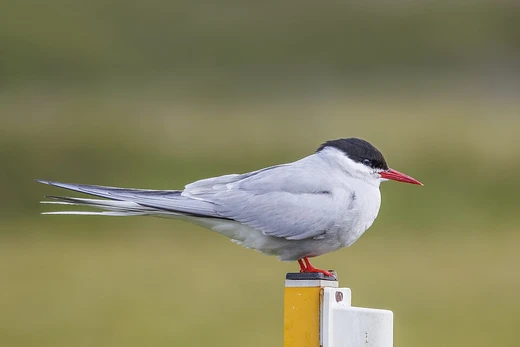
Long-billed dowitcher
A shorebird with a long bill and a disputed taxonomic history.
The long-billed dowitcher (Limnodromus scolopaceus) is a medium-sized shorebird from the sandpiper family, Scolopacidae. Its genus name comes from Ancient Greek *limne* ("marsh") and *dromos* ("racer"), while the species name *scolopaceus* is Neo-Latin for "snipe-like," derived from Latin *scolopax*. The English name "dowitcher" is of Iroquois origin and was first recorded in 1841. This bird was first described by Thomas Say in 1823 under the name *Limnodromus scolopacea*.
For about a century, the long-billed and short-billed dowitchers were considered two distinct species. By 1927, the long-billed was reclassified as a subspecies of the short-billed, the western form, due to observations of birds that seemed intermediate. It wasn't until Frank Pitelka's 1950 monograph that the two were again accepted as separate species. Genetic research later estimated they diverged more than four million years ago. The long-billed dowitcher belongs to the order Charadriiformes, family Scolopacidae, and subfamily Scolopacinae (along with snipes and woodcocks). Its genus, *Limnodromus*, includes only two other species: the short-billed dowitcher and the Asian dowitcher.
In breeding plumage (roughly May to late August or early September), adults have a dark crown, a rufous neck, chest, and belly, with black bars on the breast and white barring on the flanks when feathers are fresh. As feathers age, the black bars may fade, leaving the breast dark reddish. The crown and back are a mix of brown, black, and buff, while the wings and upper back are mottled black, buff, and white, appearing overall dark brown. The tail is barred black and white, with black bars nearly twice the width of the white, and there is a large white rump that extends to the middle of the back—visible only in flight. The bird has a whitish supercilium and a dark loral stripe that continues past the eye.
In non-breeding plumage, adults are drab gray, with darker upperparts and breast contrasting with a paler white belly; the gray of the breast gradually lightens toward the chin. At this time, the long-billed dowitcher is very difficult to distinguish in the field from the short-billed dowitcher, especially in winter when plumages are nearly identical. The best distinguishing field mark is their flight call. Juvenile plumage is similar to breeding adults but paler. Juveniles can be told from short-billed
- Scientific name
- Limnodromus scolopaceus
- First described
- 1823 by Thomas Say
- Order
- Charadriiformes
- Family
- Scolopacidae
- Genus
- Limnodromus
- Length
- 11.4 inches (29 cm)
- Wingspan
- 18.5–19.3 inches (47–49 cm)
Lore & Background
The long-billed dowitcher breeds in northern Alaska and Siberia, favoring wet freshwater meadows and marshes. Its breeding plumage features a rufous head and underparts with a darker mottled back and a large white upper rump visible only in flight. Males court females by singing and then pursuing them in flight, displaying speed and agility; pairs are monogamous for a single breeding season. The species feeds by probing with a 'sewing machine' motion in shallow water, consuming insect larvae, crustaceans, and mollusks, and is known to forage at night during migration.
Reader's Guide
The long-billed dowitcher's significance lies in its complex taxonomic history and its role as a case study in avian species delimitation. For about a century after its description, it was alternately considered a distinct species or a subspecies of the short-billed dowitcher, until Frank Pitelka's 1950 monograph confirmed their separation. Genetic research later estimated the two species diverged over four million years ago. The long-billed dowitcher is distinguished from its short-billed counterpart primarily by its flight call, especially in winter when plumages are nearly identical. Ecologically, it prefers freshwater habitats and breeds farther west and north, while the short-billed dowitcher favors saltwater and breeds eastward. Its English name, first recorded in 1841, derives from the Iroquois language. The species remains a challenge for birders and ornithologists due to its similarity to the short-billed dowitcher, particularly in winter and in overlapping ranges.
Did You Know?
- The long-billed dowitcher was first described by Thomas Say in 1823 under the name Limnodromus scolopacea.
- It was only recognized as a separate species from the short-billed dowitcher in 1950, after being considered a subspecies for decades.
- The English name 'dowitcher' comes from the Iroquois language and was first recorded in 1841.
- The genus name Limnodromus is Ancient Greek for 'marsh racer', and the species name scolopaceus is Neo-Latin for 'snipe-like'.
More in Birds of the Arctic 1-24
Spotted an error? Know more?
This is a living reference — every entry is fact-audited, and reader corrections feed straight into our audit queue. Suggest an edit · See this site's audit record