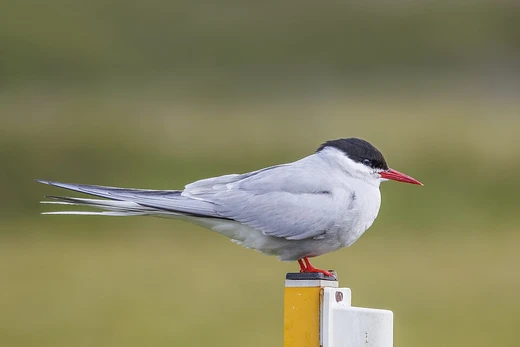
Pomarine jaeger
A seabird with disputed evolutionary origins and piratical feeding habits.
The pomarine jaeger (Stercorarius pomarinus)—also called the pomarine skua or pomatorhine skua—belongs to the seabird family Stercorariidae. It migrates and spends the winter at sea in tropical oceans.
Its place on the family tree has been debated. For a long time, the pomarine jaeger was grouped with the two smaller jaegers (the parasitic jaeger and the long-tailed jaeger) based on how their feathers looked. But early observations of behavior hinted at a different story: both the pomarine jaeger and the great skua raise their wings in a display that the smaller jaegers do not. Skeletal evidence also pointed toward a closer bond with the larger skuas. Later, mitochondrial DNA showed the pomarine jaeger’s genetic material was most like that of the great skua, not the smaller jaegers. This led to ideas that the pomarine jaeger might have arisen from a hybrid between the great skua and one of the smaller jaegers, or that the great skua came from a hybrid involving the pomarine jaeger and a southern-hemisphere skua. Under those scenarios, the hybrid group would have eventually become its own species. Whole genome sequencing later clarified things: the mitochondrial DNA match between the pomarine jaeger and the great skua is most likely the result of hybrid introgression—the pomarine jaeger’s mitochondrial DNA replaced that of the great skua. The full genome data ruled out a hybrid origin for the pomarine jaeger itself, finding no sign of parasitic or long-tailed jaeger ancestry inside it, though it did confirm a low level of gene flow between the pomarine jaeger and the great skua.
The name “jaeger” comes from the German *Jäger*, meaning “hunter.” The genus name *Stercorarius* is Latin for “of dung,” because people once thought the food that other birds spit up when chased by skuas was excrement. The species name *Pomatorhinus* comes from Ancient Greek *poma* (“lid”) and *rhis* (“nostril”), referring to the cere that this bird shares with other skuas. Despite a common mistake, the name has nothing to do with the Baltic region of Pomerania.
In size, this species ranges from 46 to 67 cm long (including the breeding adult’s elongated central tail feathers, which add about 10 cm), with a wingspan of 110 to 138 cm and a weight of 540 to 920 g. Telling it apart from the parasitic jaeger is tricky, especially because it comes in three color morphs. Pomarine jaegers
- species
- Stercorarius pomarinus
- family
- Stercorariidae
- length
- 46–67 cm (including tail streamer)
- wingspan
- 110–138 cm
- weight
- 540–920 g
- breeding range
- Far north of Eurasia and North America
- wintering range
- Tropical oceans
Lore & Background
The pomarine jaeger breeds on Arctic tundra and islands, laying 2–3 olive-brown eggs in grass-lined depressions. Like other skuas, it defends its nest by flying at the head of intruders. It feeds on fish, carrion, scraps, smaller birds, and rodents, especially lemmings, and robs gulls, terns, and gannets of their catches. Only the great black-backed gull, white-tailed eagle, and golden eagle are known to take adult, healthy pomarine jaegers.
Reader's Guide
The pomarine jaeger is significant for its complex taxonomic history, which illustrates how multiple lines of evidence—behavioral, skeletal, mitochondrial DNA, and whole genome sequencing—can yield conflicting conclusions about evolutionary relationships. Early plumage similarities placed it with smaller jaegers, but wing-raising displays and skeletal data linked it to larger skuas. Mitochondrial DNA initially suggested a hybrid origin with the great skua, but whole genome sequencing later rejected that hypothesis, attributing the mitochondrial similarity to introgression. This case highlights the importance of genomic data in resolving phylogenetic disputes. The species also exemplifies piratical feeding behavior, harassing other seabirds to steal their catches, a trait shared with most skuas. Its identification is complicated by three morphs and similarity to the parasitic jaeger, especially in juveniles.
Did You Know?
- The word 'jaeger' is derived from the German word Jäger, meaning 'hunter'.
- The specific name Pomatorhinus refers to the cere, from Greek words for 'lid' and 'nostrils'.
- The pomarine jaeger has three morphs: light, dark, and intermediate.
- Whole genome sequencing rejected a hybrid origin for the pomarine jaeger, finding no evidence of parasitic jaeger or long-tailed jaeger ancestry within it.
More in Birds of the Arctic 1-24
Spotted an error? Know more?
This is a living reference — every entry is fact-audited, and reader corrections feed straight into our audit queue. Suggest an edit · See this site's audit record